
Google Ads rewards expertise. The interface is dense. The options are overwhelming. And the penalty for wrong settings – broad match gone wild, uncapped budgets, ignored negative keywords – is real money disappearing overnight. Using chatgpt for google ads levels the playing field, giving lean teams the optimization power that used to require a dedicated PPC specialist.
Here is what to look for, what to avoid, and how to build a workflow that actually improves your campaigns.
What Most Google Ads Automation Misses
Google’s built-in automation is designed to serve Google’s interests. Smart Bidding optimizes for conversions as Google defines them. Performance Max spreads budget across every surface Google owns. These tools work, but they work best for Google’s revenue – not necessarily yours.
The missing layer is independent AI that optimizes for your goals, not the platform’s. Something that sits between you and Google’s recommendations, filtering what actually helps from what just increases your spend.
Google will always recommend you spend more. You need a tool that recommends you spend better.
Most teams accept Google’s suggestions because they lack the expertise to evaluate them. That is where AI-powered tools built for advertisers – not ad platforms – make the biggest difference.
What a Good AI-Powered Google Ads Tool Does
Intelligent Keyword Management
Beyond basic keyword research, the right tool monitors search term reports continuously and adds negatives automatically. It identifies wasted spend from irrelevant queries before you even see the report. Manual negative keyword management is a time sink that AI eliminates entirely.
Bid Optimization Independent of Google
Google’s Smart Bidding has a conflict of interest. Independent AI bid management sets bids based on your target CPA or ROAS, adjusting in real time based on auction dynamics, time of day, device, and audience signals. This layer of chatgpt advertising technology reduces overbidding on low-value clicks that Google’s algorithm does not penalize.
Ad Copy Generation and Testing at Scale
Responsive Search Ads need 15 headlines and 4 descriptions. Most advertisers recycle the same angles across ad groups. AI generates fresh, keyword-relevant variations and tracks which combinations Google serves most and which actually convert. The difference matters – Google’s “best” performing combination is not always your most profitable one.
Budget Pacing That Protects Your Spend
Overspending early in the month and running dry by week three is a common problem. Strong tools pace your budget based on conversion patterns, not just daily averages. They account for day-of-week and time-of-day performance curves that flat daily budgets ignore.
Four capabilities of AI-powered Google Ads tools: smart keyword management, independent bidding, ad copy at scale, and budget pacing
Building a Better Google Ads Workflow
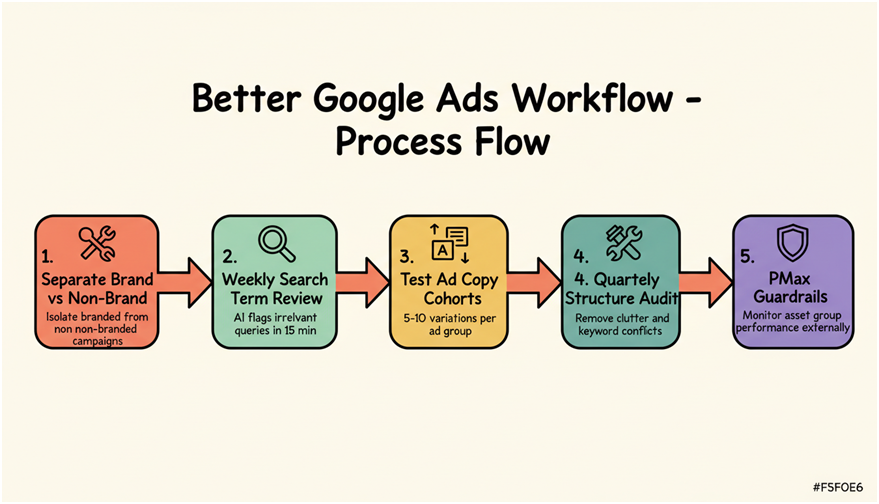
Separate branded and non-branded campaigns completely. Branded searches convert at fundamentally different rates. Mixing them inflates your perceived performance and hides where non-branded campaigns are actually struggling. AI tools that unify reporting across campaign types help you see the real picture.
Review search terms weekly with AI assistance. Instead of scanning hundreds of queries manually, use chatgpt google ads tools to flag irrelevant terms, cluster related queries, and suggest negative keywords. A 15-minute weekly review replaces what used to take two hours.
Test ad copy in cohorts, not one-offs. Write 5-10 variations per ad group and let AI monitor which ones earn the best Quality Score and conversion rate. Leading chatgpt advertising platforms automate this testing cycle and compound small improvements into significant gains over 90 days.
Audit your campaign structure quarterly. Google Ads accounts accumulate clutter – old campaigns, paused ad groups, duplicate keywords. AI tools can audit structure and flag conflicts like keywords competing against each other in the same account. Clean accounts perform better.
Never accept Performance Max without guardrails. Performance Max campaigns hide where your money goes. If you run them, use external tools to monitor which asset groups drive results and which channels consume budget without converting.
Five-step Google Ads workflow: separate brand vs non-brand, weekly search term review, test ad copy cohorts, quarterly structure audit, and Performance Max guardrails
What Inaction Costs You
Advertisers using AI-powered optimization on Google Ads are cutting wasted spend by 30-40%. On a $20,000 monthly budget, that is $6,000-$8,000 per month reclaimed. Over a year, that is enough to fund an entire new channel or hire a team member.
Your competitors in the same auctions are already using these tools. They bid smarter. Their Quality Scores are climbing. Their CPCs are dropping while yours stay flat or increase.
Google Ads is an auction. When your competitors get more efficient, your costs go up – even if you do nothing differently. Standing still in a competitive auction is not neutral. It is actively losing ground.
The tools are accessible. The learning curve is minimal. The only question is how much more you are willing to overpay before you adopt them.